A linocut Janka Kupała by Barys Zaboraŭ, included in the compilation Selected Lyrics (Minsk, 1967), which the artist donated to the Skaryna Library.
Janka Kupała was born 140 years ago – on 7 July 1882 – on the Kupała (or Kupalle) day; this led him to his pen name. His family was not wealthy, but they did not beg either: parents often moved from farm to farm, from lord to lord, where they rented land. They gave Janka a good, albeit simple, education – from travelling teachers and in primary schools. He had access to books – wealthier neighbours often had libraries.
Kupała began to write poetry in Polish, his first published poems were in Polish as well. Once he came across the books of Bahuševič and Dunin-Marcinkevič, he was deeply impressed that fine literature could be created in Belarusian too. He never looked back.
Fame came to Kupała almost instantly. Many looked up to him and were inspired by him. But his life was not carefree. In the BSSR, he was either praised or accused of counter-revolutionary nationalism. Thousands of people perished in Stalin’s purges before his eyes. Due to unbearable accusations, he tried to kill himself in 1930. Despite all the pressure, he held on, created wonderful poetry, developed new themes and genres, and supported other creators.
If Kupała were with us today, we know how he would answer the question which refers to the most prominent Ukrainian poet, Taras Shevchenko:
Why did Taras’s song / echo, sang / in the hearts of Belarusians / with understandable words?
Perhaps, like hundreds of thousands of our compatriots, he would also be forced out of Belarus:
Because the fate of the Belarusian / together with the fate of the Ukrainian / – in sweat, in tears walked / along the thorny road.
(Poem Tarasova dola, 1939)
In the life of Kupała, we recognise our own lives and the whole nation. Like his family, we often work hard, selflessly raise children, and leave for neighbouring countries and distant lands for a better life. Occasionally, we discover unexpected values that we hadn’t thought about before, which suddenly change everything for us. Like Kupała, we adapt to what we cannot change and suffer from it. Amid sweat and tears, we also find the reasons for joy.
Kupala showed that Belarusian identity does not equal ideology. It is like air: we can breathe it easily, almost imperceptibly for ourselves. It empowers us.
Poem Kurhan (The Mound)
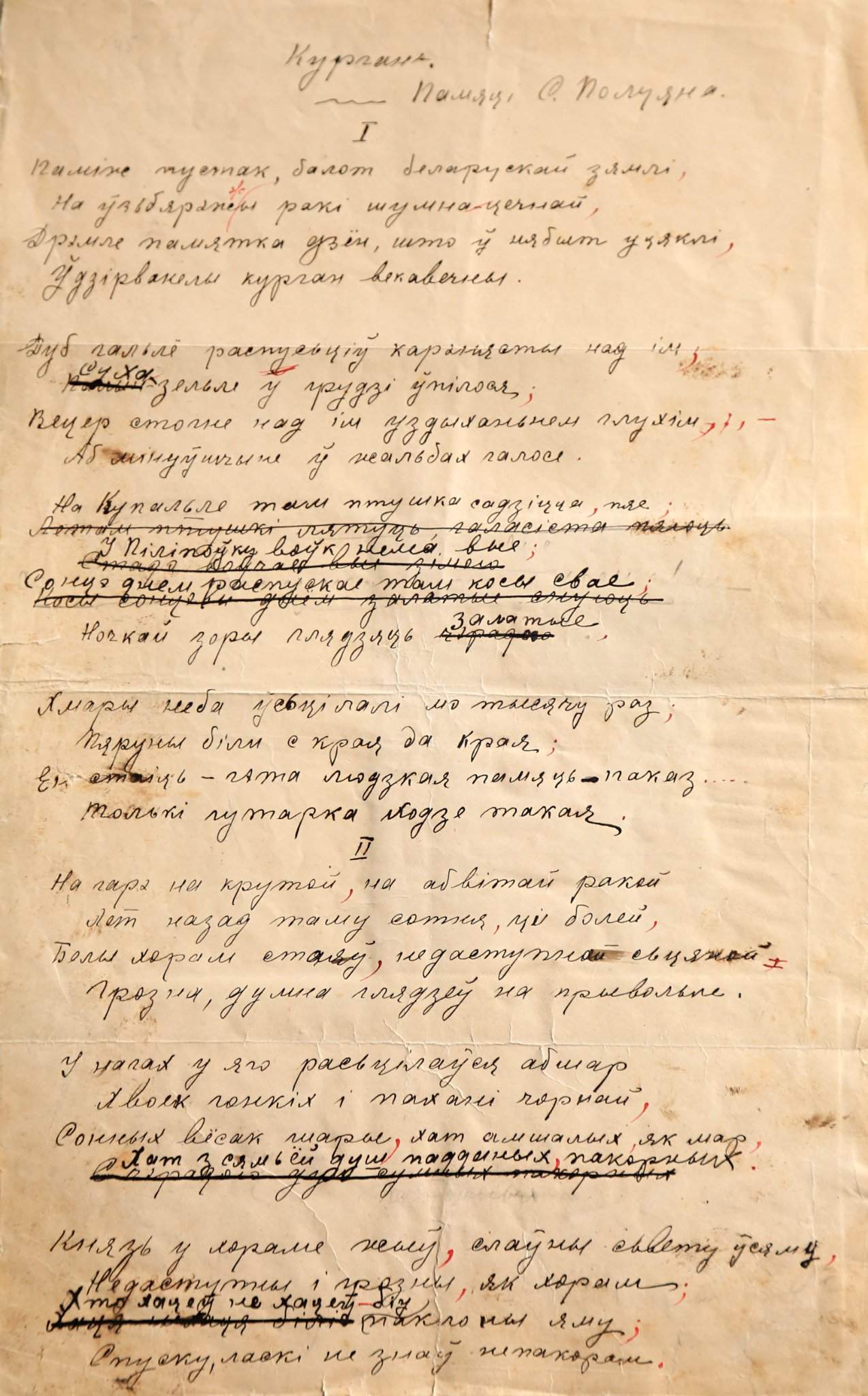
110 years ago, on 21 June 1911, the newspaper Naša Niva published Janka Kupała’s poem Kurhan (The Mound).
Our Library preserves its complete manuscript. It was donated to the Library by Leanid Halak, a Belarusian public figure in the USA.
Žalejka (The Hornpipe) – The First Book

The first book of poems Žalejka (The Hornpipe) by Janka Kupała was published in Saint-Petersburg in 1908. The first edition of this book is preserved in our collection.
Poem Huśliar (The Gusli Musician)
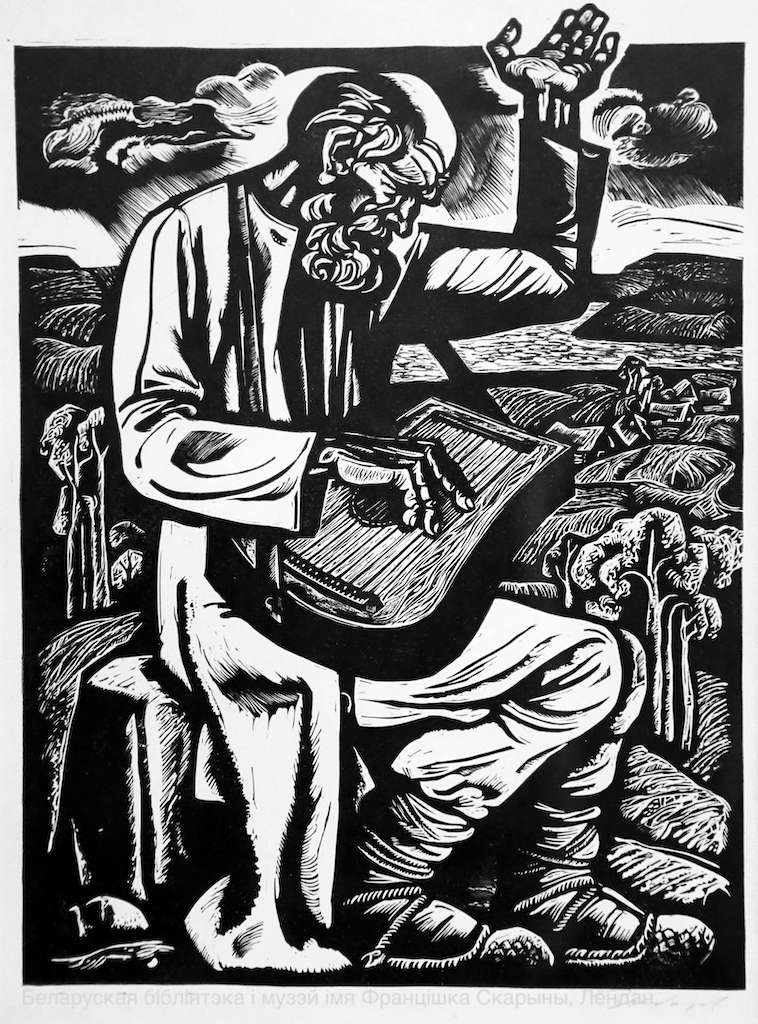
A linocut by Barys Zaboraŭ, which the artist donated to the Skaryna Library – an illustration to Janka Kupała’s poem Huśliar (The Gusli Musician), included in the compilation Selected Lyrics (Minsk, 1967).
The poem Huśliar was first published in the compilation of the same name (St. Petersburg, 1910). It was written a few years earlier when it became clear that the 1905 revolution in the Russian Empire ended in defeat. In this context, Huśliar words resonate with our time: he calls on the gusli musician to awaken the world to a new campaign, to a new life.
From barn to barn
You reign, Huśliar!
Give the torches heat,
And life to woods-ravines,
Don’t omit any windows;
A formation of warriors align,
Warm the blood like brew,
With the words of new days …
Play, awake them, Huśliar!
Poem Adviečnaja Pieśnia (The Eternal Song)
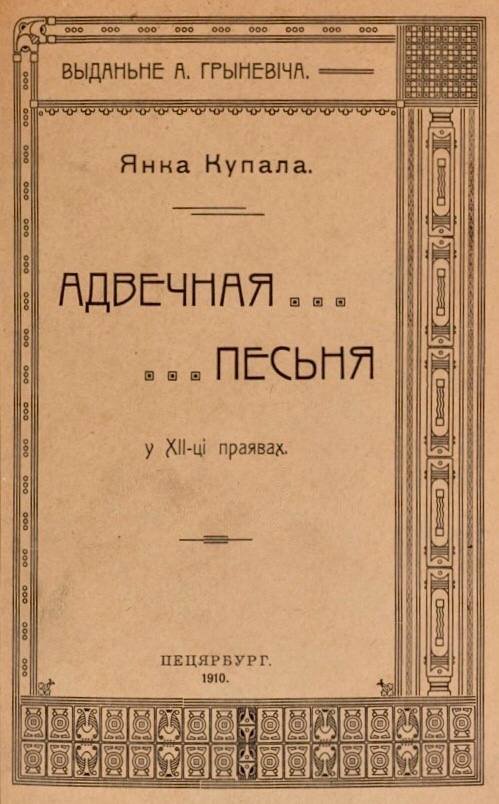
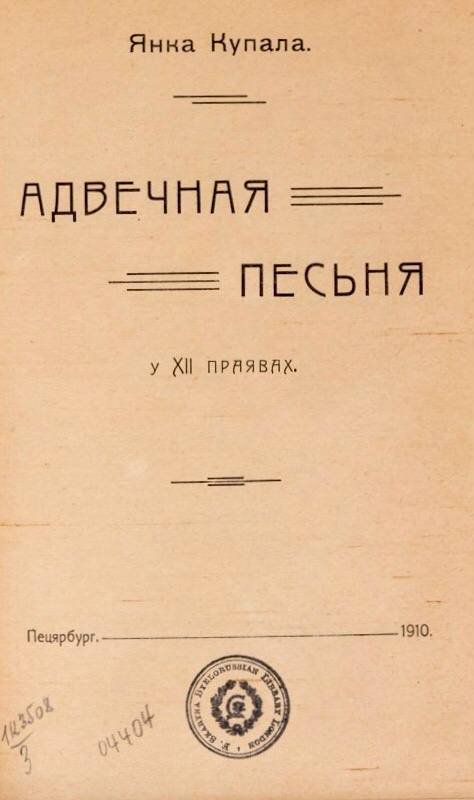
A copy of the first edition (St Petersburg, 1910) of Adviečnaja Pieśnia (The Eternal Song) from the Skaryna Library collection.
Janka Kupała worked in the library – it’s true! In 1908, the Luckievič brothers invited him to move to Vilna where he worked at the private library Znaniye. At the same time, he collaborated with the first Belarusian weekly, Naša Niva. He arrived in Vilna with the recently written dramatic poem Adviečnaja Pieśnia (The Eternal Song) – his first dramatic work in verse. In this poem, the life of a man, a peasant, portraited gloomy and pessimistic:
Reopen again, grave:
People and the world are scarier than you.
The year spent in Vilna was very happy for Kupała: his poetry here began to acquire a remarkable beauty and breadth. Naša Niva enthusiastically wrote that “Kupała is facing a great future.”
Poem Pieśnia Zvanara (The Song of the Bell Ringer)
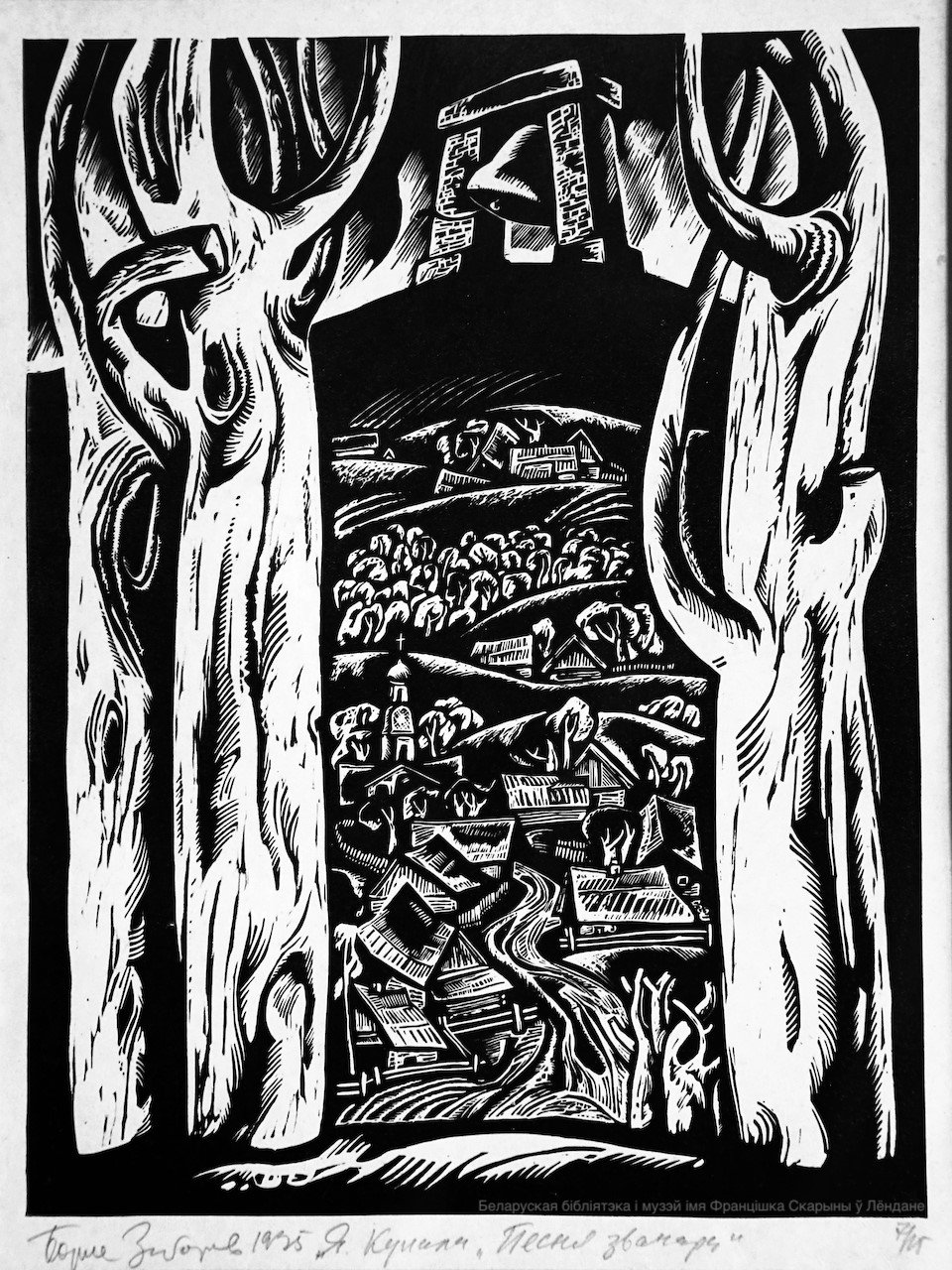
Bаrys Zaboraŭ’s linocut Pieśnia Zvanara (The Song of the Bell Ringer), an illustration to the homonymous poem by Janka Kupała (part of the compilation Selected Lyrics, Minsk, 1967), was donated to the Skaryna Library by its author.
In the “Song” written in 1909, Kupała returns to the image of the singer (“pieśniar”), the prophet who awakens the people:
And I’ll put up a bell, to be heard from all sides –
An equal voice both to whirlwind and thunder.
When in motion it’s set, it will summon a dance,
Round dance, no one will sit at home!
And from window to window my bell will be heard,
Awakening souls and striking hearts,
Shaking shackles of dungeons, setting sparks of lightning flash,
Stirring ravines and ferns-covered forests.
The poem has been set to music and цфы performed by the once-popular Belarusian band Pieśniary. https://youtu.be/CbmuRx-HBLw
Poem Chaŭruśnikam (To the Allies)

The poem’s manuscript signed ‘Janka Kupała’ was donated to the Skaryna Library by Leanid Halak, a Belarusian public figure in the US. An interesting fact is that when this poem was published in the literary journal Polymia (The Flame) in 1929, it was signed under the pen name ‘Cimoch Karuz’.
In 1913 Janka Kupała wrote his poem Chaŭruśnikam (To the Allies) in which he condemned the eastern and western neighbours coveting Belarusian lands. The poet remarkably accurately predicted the Russian-Polish partition of Belarus, which would take place following the Peace of Riga eight years later:
One part is given to Warsaw
To lick their boots,
The other is going
To suckle Moscow.
But what they forgot,
The allies of the night,
Is to ask the Belarusian
What he wants to be.
Poem Son na kurhanie (A Dream on a Mound)
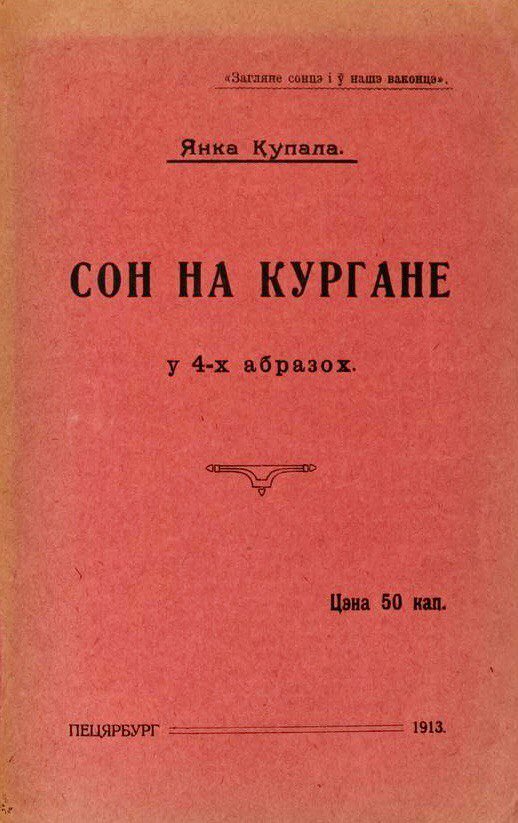
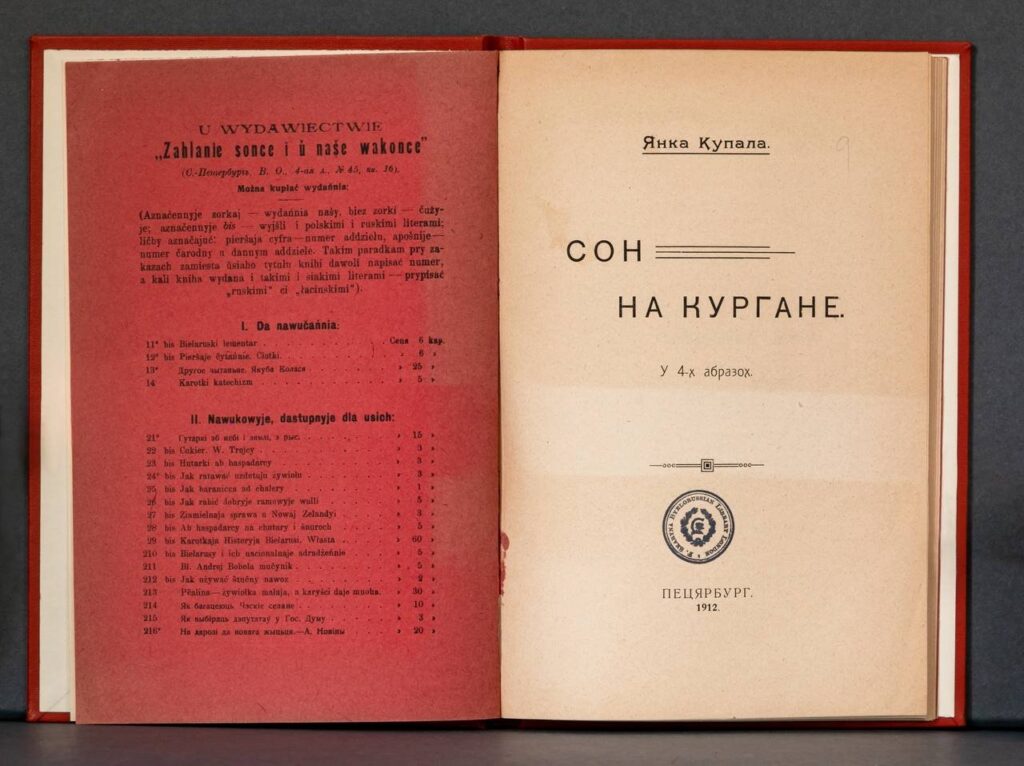
A copy of the first edition of the poem Son na kurhanie (A Dream on a Mound; St Petersburg, 1913) is preserved in the Skaryna Library in London.
●
Like many of Kupała’s works, the dramatic poem Son na kurhanie (A Dream on a Mound) strongly resonates with our time. It was written during the years of the revenge of the Russian authorities following the defeat of the 1905 revolution – during the time of mass persecution and military courts. Kupała later called that regime “the kingdom of night and darkness.” Many members of the Belarusian movement were imprisoned or exiled to Siberia, there were no clear prospects for a better life and ending the repressive machine.
…They tore out happiness, they tore out their eyes, / Thoughts are soiled by the failure; / The paths got obscured by the night darkness, / They dig ditches with no end to be seen.
Here we are drunk, ah, drunk / By our eternal damnation: / While healing eternal wounds, / The new ones we cause.
The content of the poem is not limited to a response to post-revolutionary events. It is a wonderful example of Kupała’s romanticism. He calls people and the whole nation to self-discovery, to recover the people’s memory and to awaken its spiritual forces. His language is full of symbolism and allegories so characteristic of this genre.
Poem Pamiaci Vincuka Marcinkieviča (In Memory of Vincuk Marcinkievič)
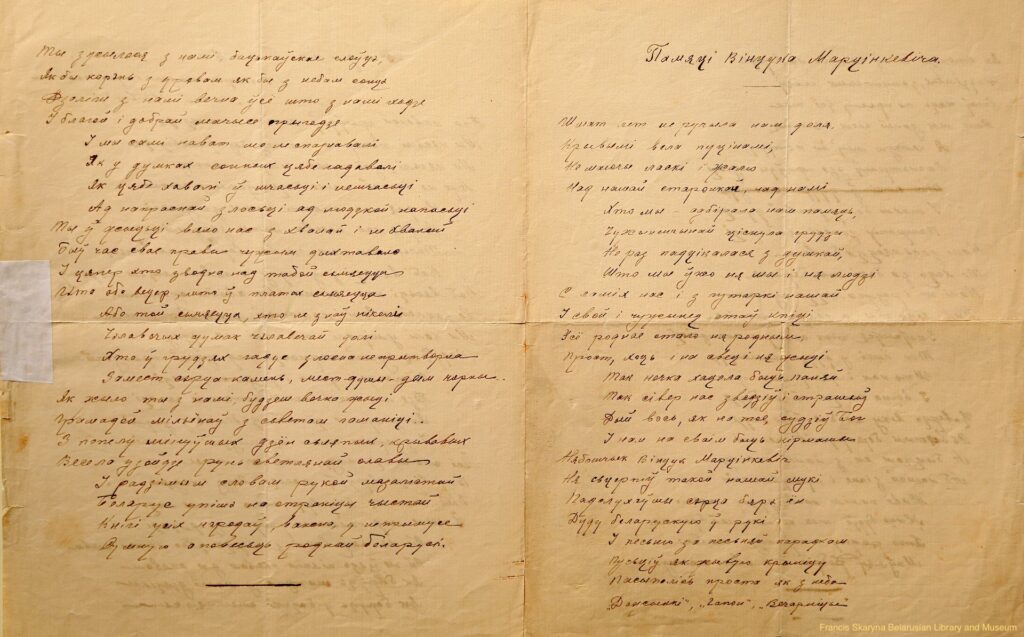
Among the autographs of Janka Kupała, which were donated to the Skaryna Library by Leanid Halak, is a manuscript of the poem Pamiaci Vincuka Marcinkieviča (In Memory of Vincuk Marcinkievič). Written on the 25th anniversary of the death of Vincent Dunin-Marcinkievič, one of the founders of the new Belarusian literature, the poem was first published in the Naša Niva newspaper in 1910 along with other materials dedicated to the writer. The theme of continuity is clearly noticeable in the poem: Dunin-Marcinkievič for Kupała is a Belarusian dudar (bag-piper), who first “began to sow in his own way all that we continue to sow today.”
Later, in the 1920s, Kupała translated into Belarusian the Polish-language verse excerpts from Dunin-Marcinkievič’s comedy Idylija (Idyll).
Book Šliacham žyccia (On Life’s Journey)
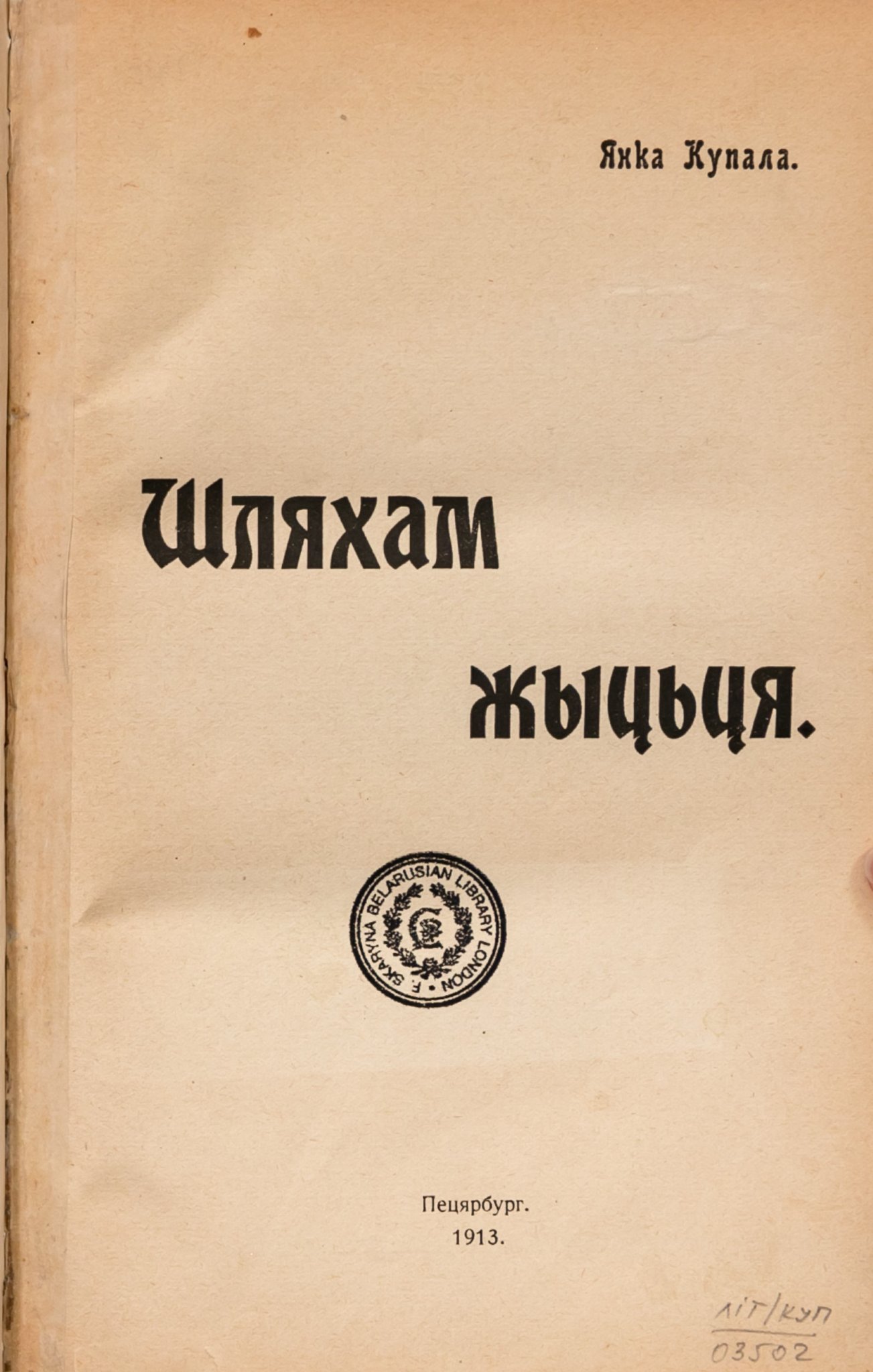
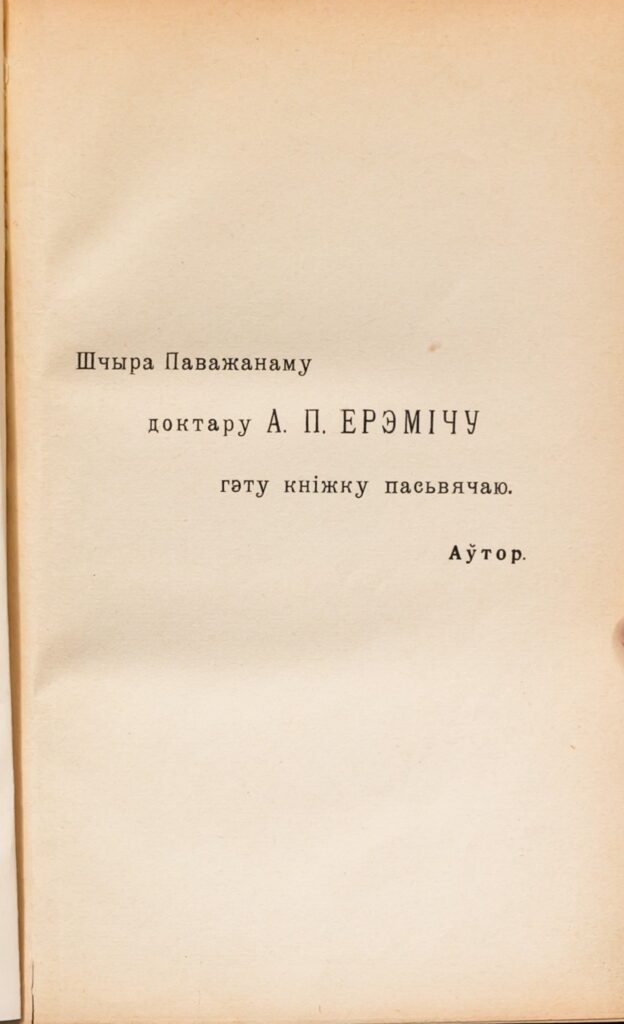
Janka Kupała’s compilation of poems Šliacham žyccia (On Life’s Journey), published in St. Petersburg in 1913, was dedicated to the surgeon and philanthropist Aliaksandr Jaremič, who funded the publication. A copy of this publication has its place of honour on the shelves of our library.
Today, when we are once again looking for ways for Belarusian national revival, the call of Kupała’s prophet to “rise up, go, light up the night” is no less relevant than in the days of Kupała:
It’s time to take up torches, / Rise up, go, light up the night! / If you don’t take them all today, / You won’t get them tomorrow.
In spite of bloody obstacles / Drop the yokes, congregate / And let all other nations see / What a strong people you are!
Poem Prarok (The Prophet)
Poem Rodnaje słova (Native Word)
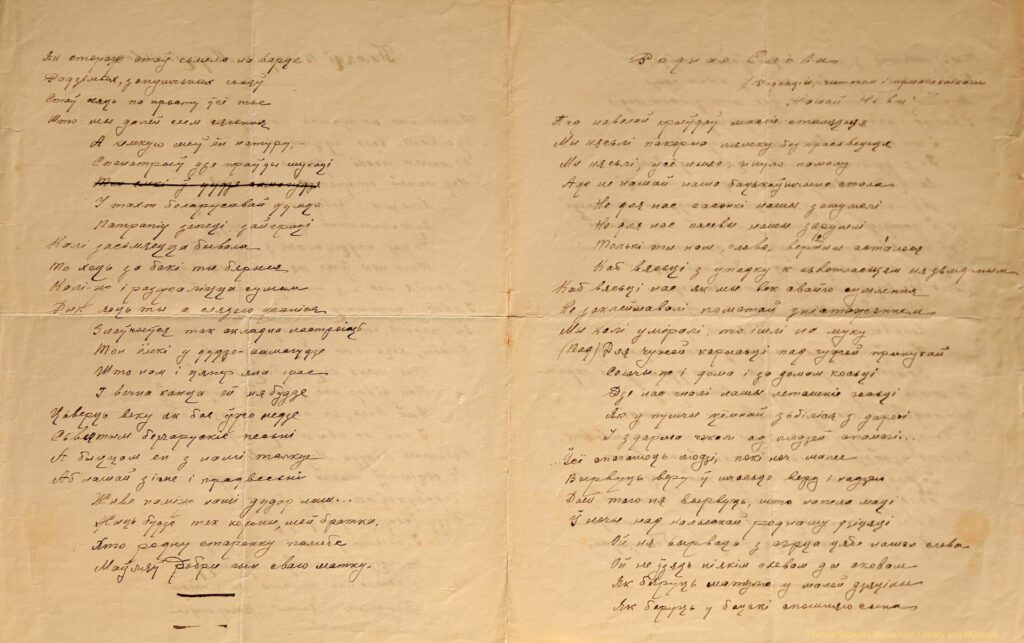
Among other pearls of Janka Kupała’s heritage, the Skaryna Library preserves an autograph of the poem Rodnaje Słova (Native Word). The poem was published in the Belarusian newspaper Naša Niva (1910, No. 51) after the Third State Duma of the Russian Empire forbade teaching Ukrainian and Belarusian children in their native language. Like all of Kupała’s work, the poem is filled with love to the mother tongue and affirms its unique importance for the preservation of Belarusian identity in times when “our homeland has become not ours.”
Under a blizzard of grievances for so many centuries
We obediently carried a yoke of hopelessness.
While we carried it, all ached and decayed slowly
Our fatherland is no longer ours.
No longer for us our pine trees rustle
No longer for us our harvests yield
But our word has remained faithful
To lead us from decline to great brightness.
It is interesting that these lines in the manuscript were written in classical Belarusian spelling and differ from later publications. A manuscript of the poem was handed over for preservation to the Skaryna Library by Leanid Halak, a Belarusian public figure in the US.
Poem Pierad Visielniaj (In Front of the Gallows)
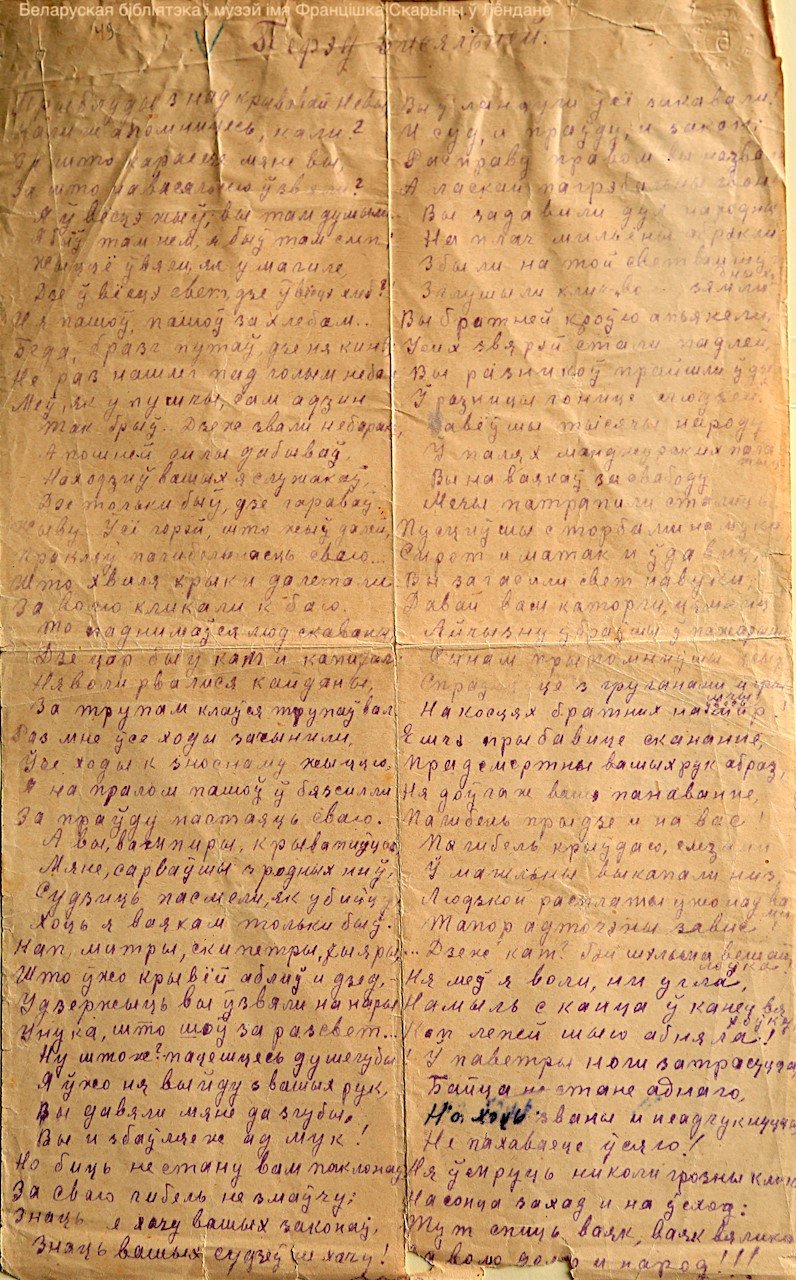
The manuscript of the poem was donated to the Skaryna Library by Leanid Halak, a Belarusian public figure in the United States.
On 28 June 1942, Janka Kupała died in Moscow in suspicious circumstances. The lines from Janka Kupała’s poem Pierad Visielniaj (In Front of the Gallows) resonate with us particularly poignantly today, on the 80th anniversary of his death.
Well, rejoice you, murderers.
Will not escape your hands –
As you brought me to destruction,
You should save me from torment.
But I will not bow down to you,
Nor will I stay silent in my death;
I don’t want to learn your laws,
I have no wish to know your judges!
The digital exhitionion for the 140th anniversaty of Janka Kupała was authored by Dr Karalina Matskevich (curator); Natallia Raisanen, Paval Shautsou, Ihar Ivanou (texts and translations); Sasha Belavokaya, Michael Sagatis (images).