Today marks forty years since the accident at the Chernobyl Nuclear Power Plant, the greatest man-made environmental catastrophe in the history of Belarus and Europe.
Belarus suffered more than any other country as a result of the Chernobyl disaster. A significant part of its territory was contaminated by radiation, while the health consequences became increasingly evident with each passing year. At the same time, the Soviet economy and healthcare system were in decline, and Belarusian hospitals often lacked even basic equipment and supplies. In these circumstances, the initiative of the Belarusian émigré community to assist the victims played a particularly important role.
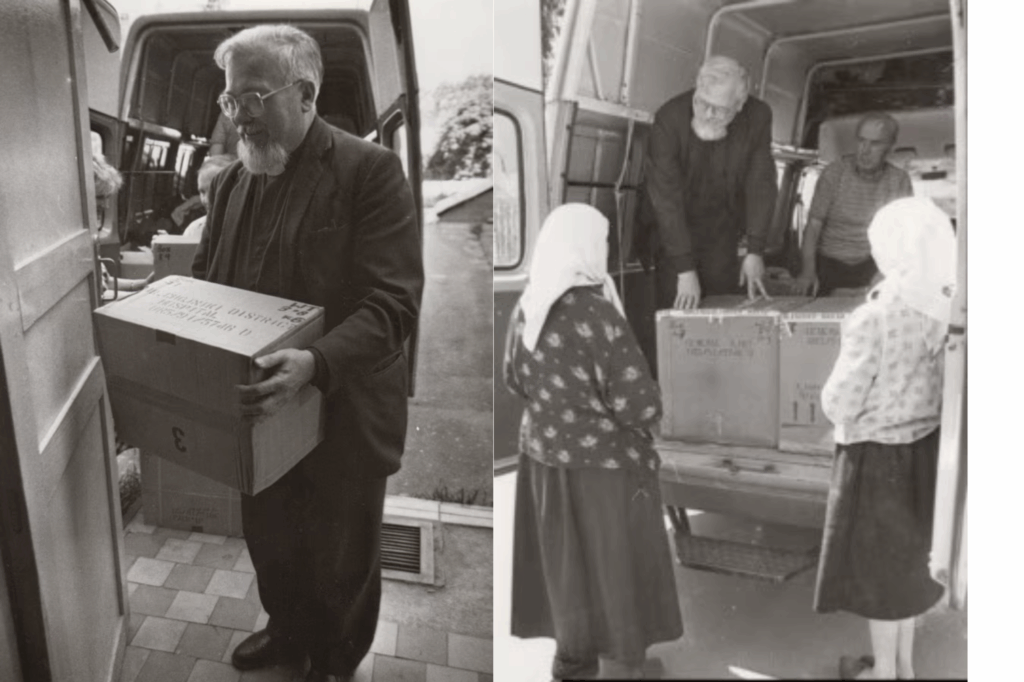
In London, in the late 1980s, the Belarusian Radiation Relief Appeal was established. Its initiator and driving force was Fr Alexander Nadson, Apostolic Visitor for Belarusians and one of the key figures of the Belarusian diaspora.
It was he who succeeded in turning pain for the homeland into concrete action. In his appeals, Fr Alexander stressed that the tragedy of Chernobyl should not lead to despair, but should become a challenge and an inspiration to act. This idea was captured in the Committee’s brief but powerful motto: “Our Pain — Our Duty.”
Under Fr Alexander’s leadership, the Committee brought together Belarusians abroad and friends of Belarus in many countries. A network of representatives was established in the United Kingdom, the United States, Canada, Australia, France and elsewhere. This made it possible to organise systematic fundraising and turn solidarity into practical assistance.
Funds raised by the Committee were used above all to purchase medicines and medical equipment for the regions of Belarus most affected by radiation. By 1990, the first major shipments of medicines and hospital equipment had become possible. In that year alone, the Committee raised more than £32,000 — a significant sum for a civic initiative at the time.
No less important was its informational work. The Committee published materials in Belarusian, English and French, communicating to the international community the true scale of the catastrophe. According to these assessments, more than a quarter of Belarusian territory — home to millions of people, including hundreds of thousands of children — had been affected by radioactive contamination, contributing to rising rates of serious illness.
The Belarusian Radiation Relief Appeal became an example of how the personal initiative and moral authority of one individual can mobilise broad solidarity and transform it into tangible aid. In this sense, the work of Fr Alexander Nadson is not only part of the history of Chernobyl, but also an important example of Belarusian civic responsibility.