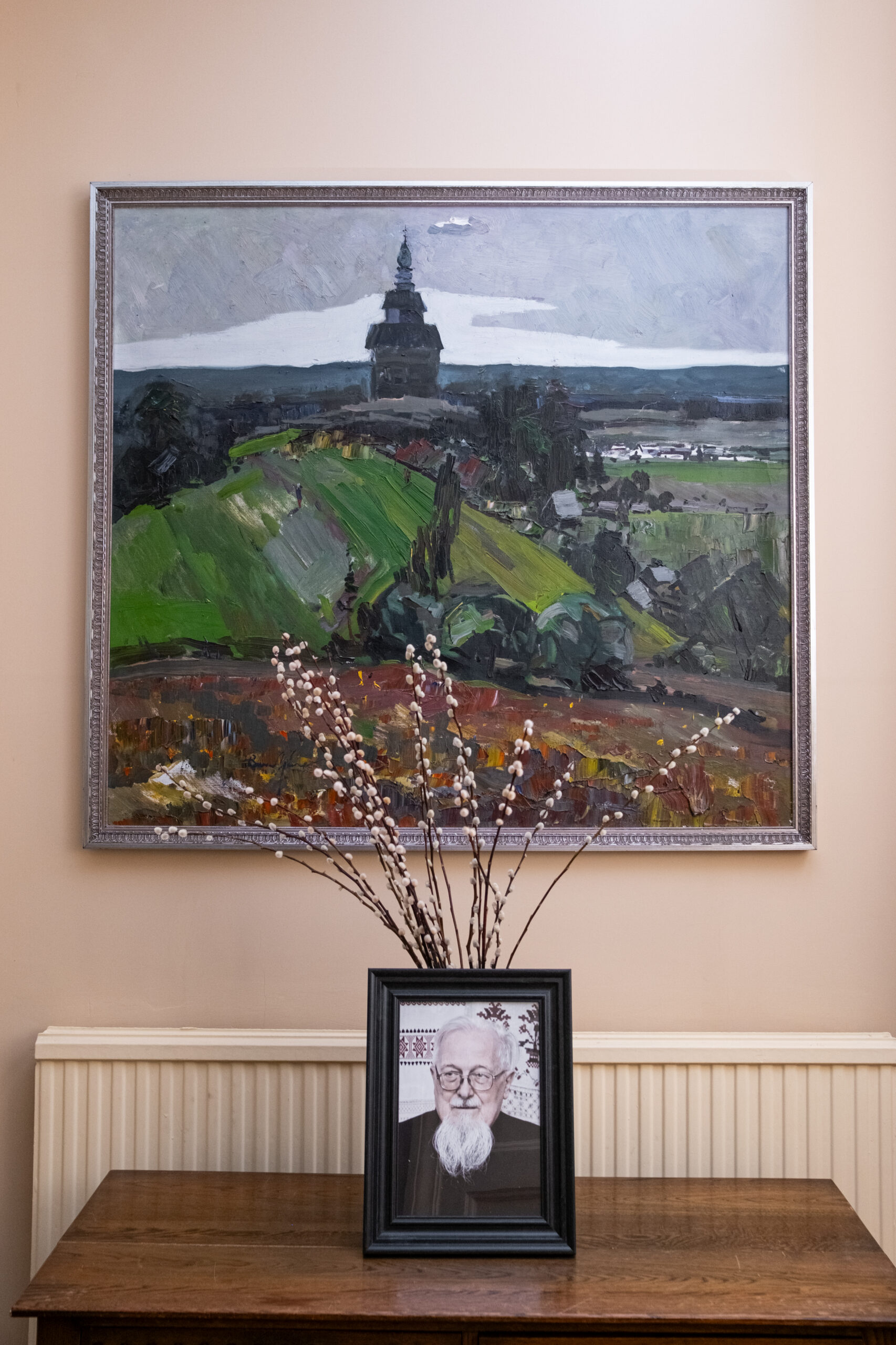
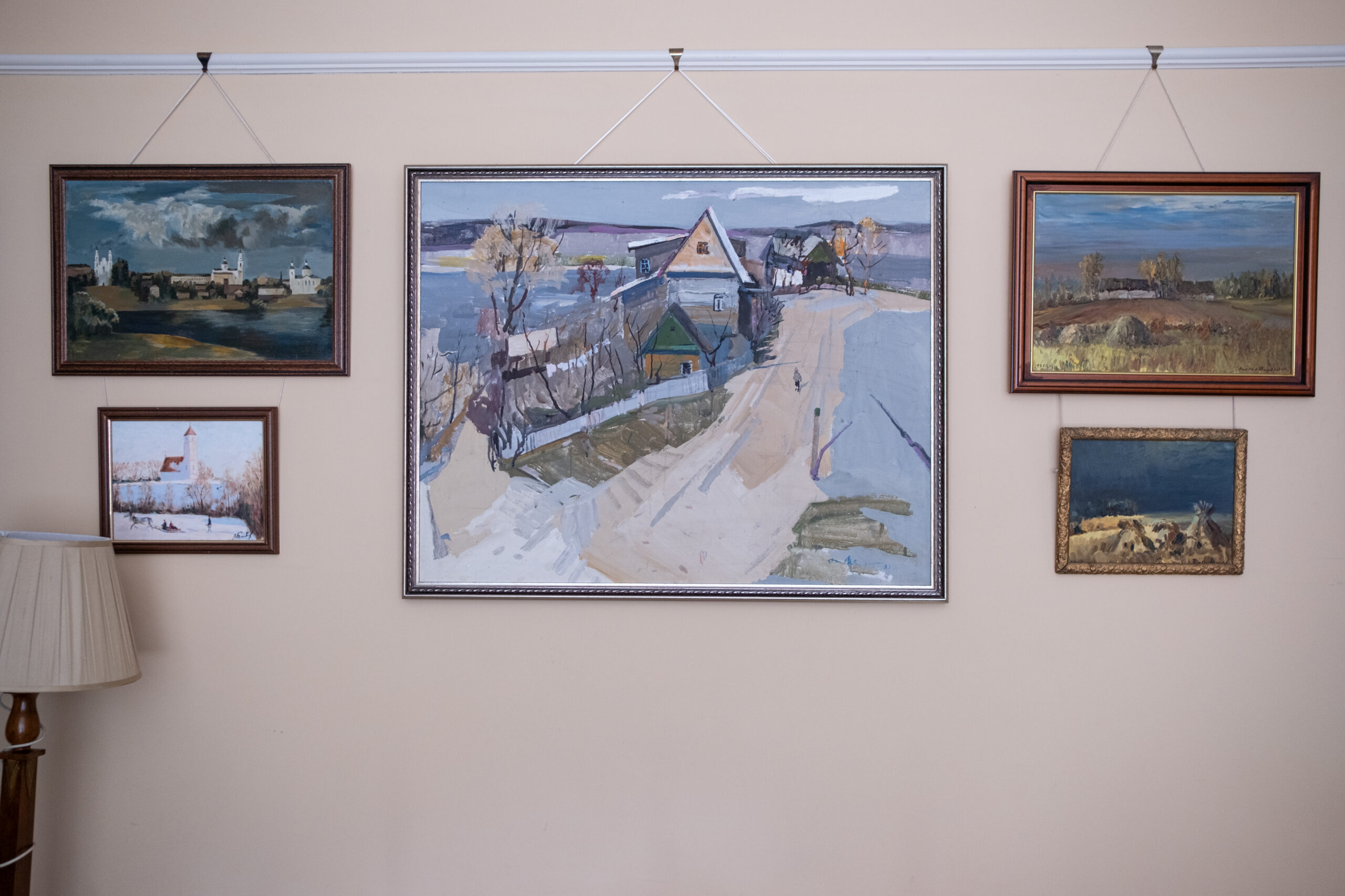
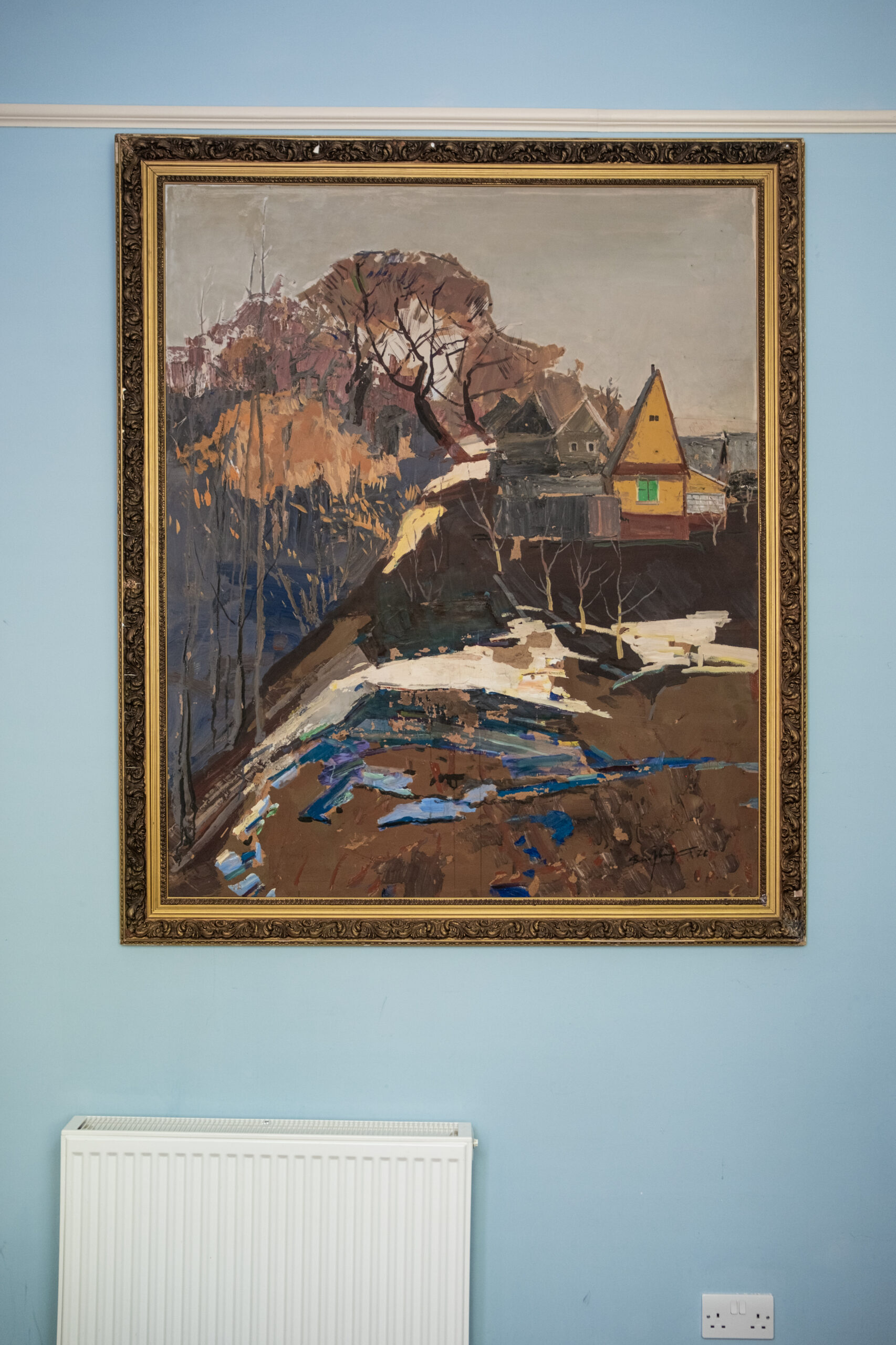
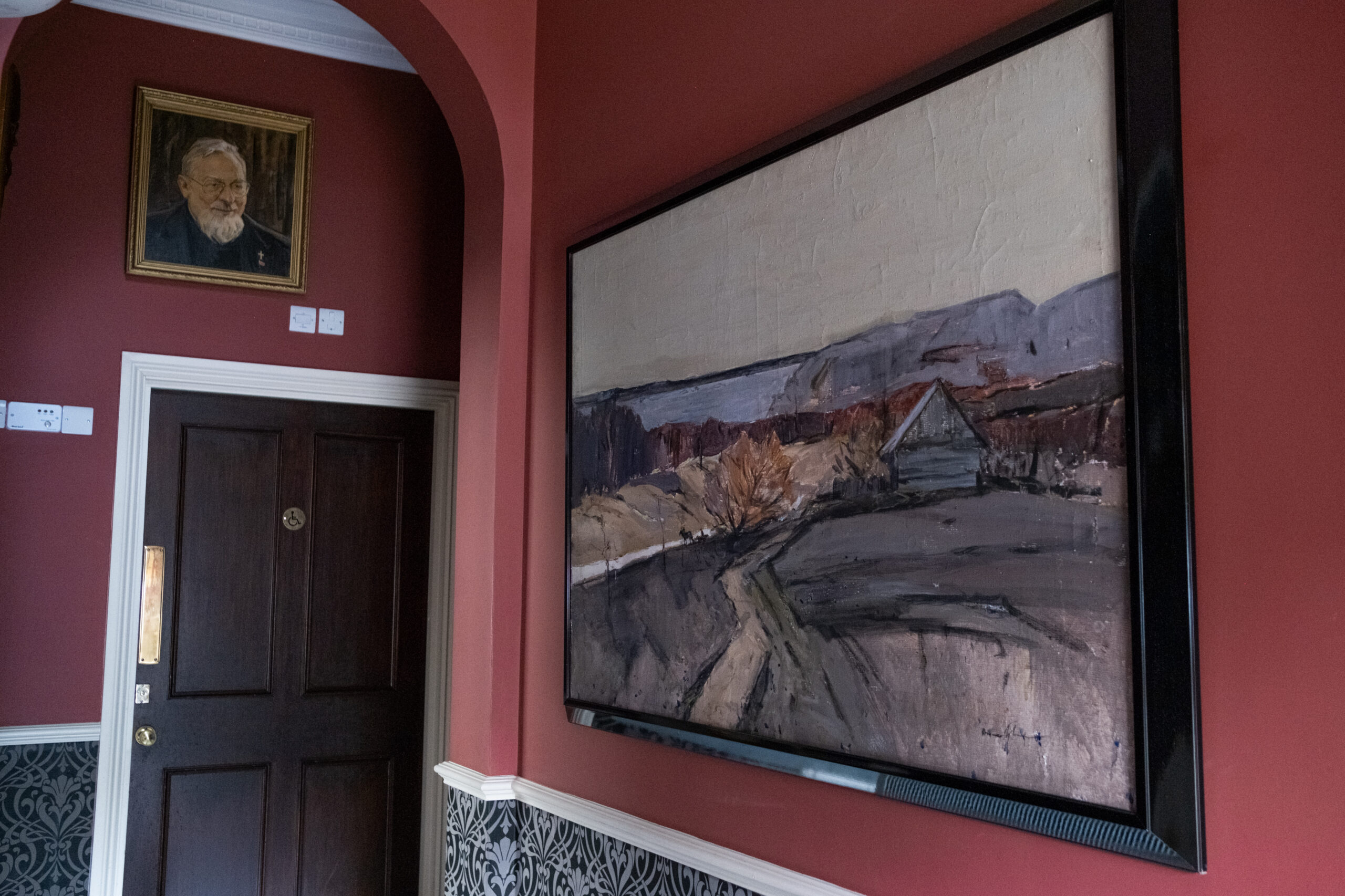
The collection donated to the Library by Iosif Levitan forms a coherent body of Belarusian paintings from the end of the 20th century. Most of it consists of canvases by Vital Ćvirka (1913, village of Radziejeva, Buda-Kašalova district – 1993, Minsk), a classic of Belarusian art and People’s Artist of Belarus. The collection includes 12 landscapes by the master, painted during the mature period of his career — the 1970s to early 1980s — and one still life. Captivated by the landscapes of Belarus, Vital Ćvirka developed his own distinctive artistic style in the 1960s. It was during this time that he created his celebrated paintings Native Horizons, Śvir, A Tale of Paleśsie, and dozens of other canvases that established his singular, instantly recognisable artistic voice.
Vital Ćvirka served as rector of the Belarusian Theatre and Art Institute and headed the Union of Artists of Belarus. His works are held in museums and galleries in Belarus, Israel, Latvia, Lithuania, Germany, Poland, Russia, and Ukraine, with the majority preserved in the National Art Museum of Belarus. A street in Minsk is named in his honour.
The works presented at the Skaryna Library show the artist’s vivid and light, sketch-like style. His landscapes are marked by an epic quality, an encompassing imagery, and a distinctive, immediately recognisable rendering of Belarusian scenery. Ćvirka sought out precisely what was typical in the distinctiveness of different corners of Belarus, from the Lake District (Paazierje) to Paleśsie. His paintings typically show the boundary between human life and the natural world — the fruits of people’s labour in the fields and orchards alongside the grand expanses of nature. At the same time, the master’s Belarusian landscapes are united by his choice of soft, muted, cool light, characteristic of the thaw season or late autumn. Standing apart within this collection is a composition in the still-life genre, unusual for Vital Ćvirka.
The collection also includes two paintings representing the classic period of Belarusian post-avant-garde art, the “new Belarusian School” of the late 1980s. One is the composition Mutants. Family IV (1989) by Alaksiej Ždanaŭ (1948, Minsk – 1993, Minsk), an artist and poet and a cultural hero of nonconformism in Belarus. Ždanaŭ was an active participant in the underground movement, belonged to the art groups Pluralis, Forma, and Corvus Caecus (“Blind Crow”). His work formed a distinctive part of the unofficial art of the 1980s. In his paintings, Ždanaŭ created a parallel, non-communicative world embodying an uncanny reality haunted by a foreboding of social collapse and a lost future. Alaksiej Ždanaŭ’s works are held in art collections in Belarus, Lithuania, Poland, Russia, the USA, and Israel. His poems were published in two posthumous collections. He translated from Belarusian poetry by Aleś Razanaŭ, whom he knew well. He took part in the exhibitions At Kalektarnaja (1987), Perspektyva (1987), and Panarama (1989). In 2013, a retrospective exhibition of Ždanaŭ’s works from private collections, titled From the Life of Mutants, or A Memory of the Future, was held at the Museum of Contemporary Fine Art in Minsk. The artist himself described his work this way: “What concerns me is mutation — specifically the mutation that began in [19]17 and continues to this day, and what I paint are mutants.”
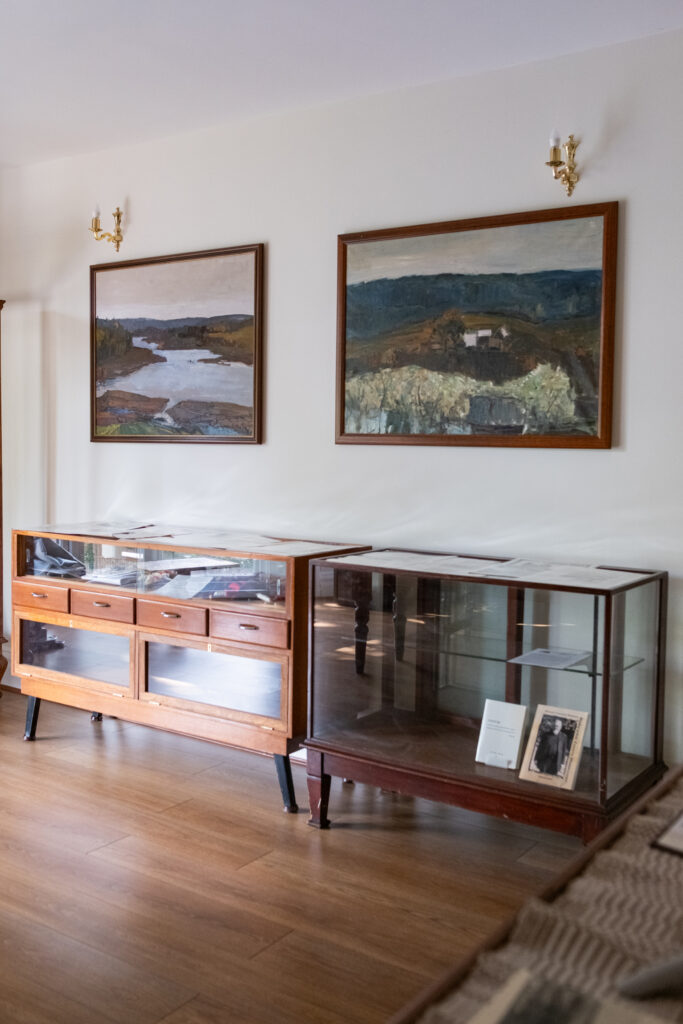 Artworks from the Iosif Levitan collection on display at the Francis Skaryna Belarusian Library and Museum, London. Photo by Tania Niden
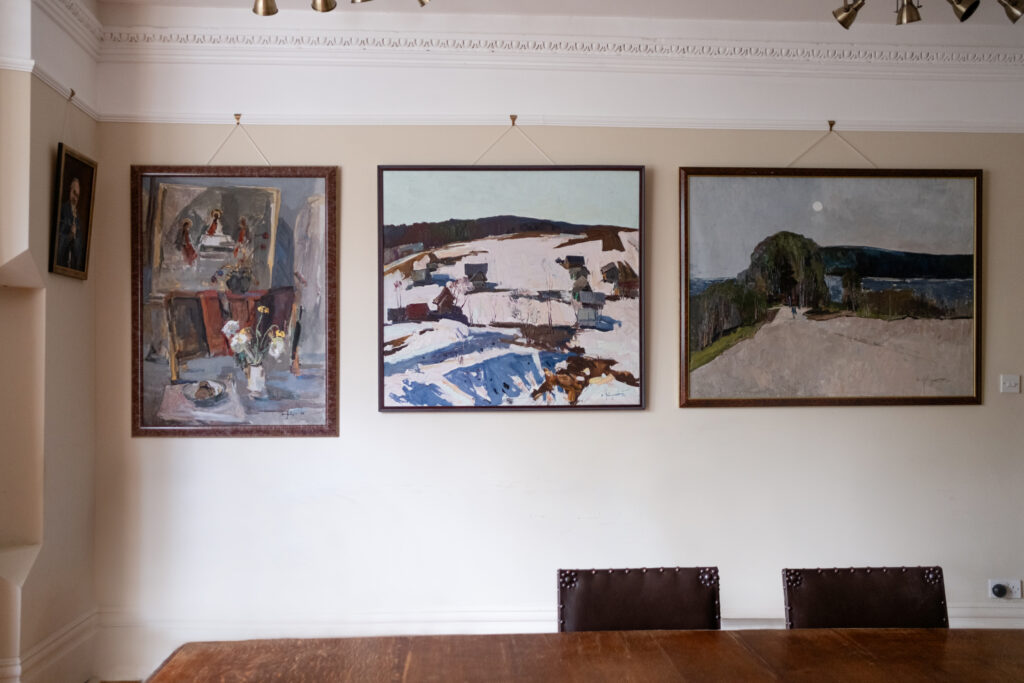 Artworks from the Iosif Levitan collection on display at the Francis Skaryna Belarusian Library and Museum, London. Photo by Tania Niden
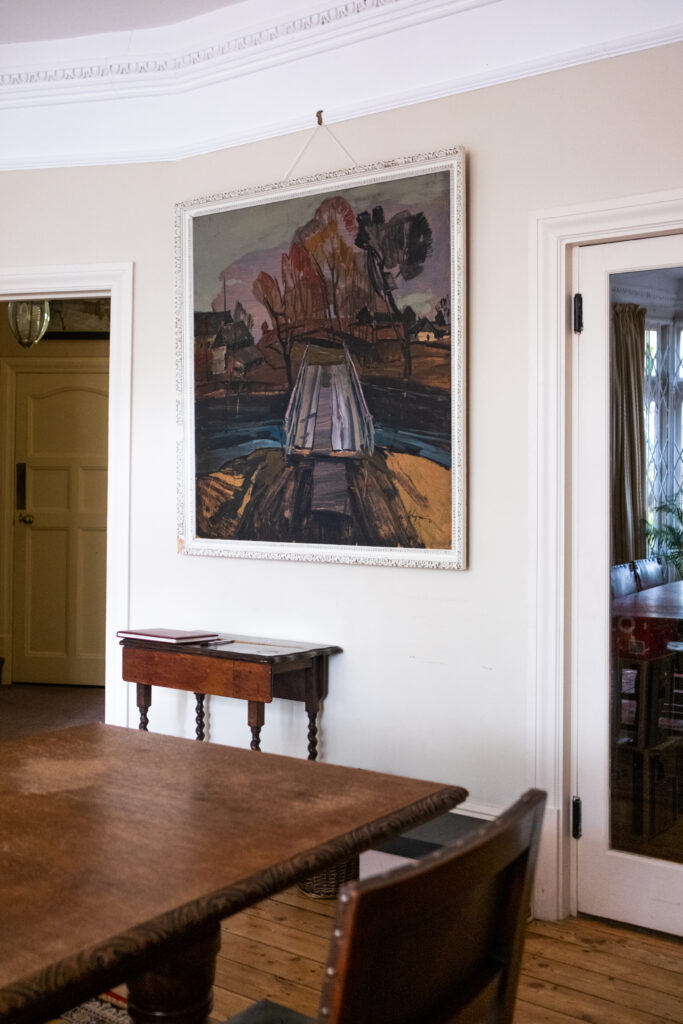 Artwork from the Iosif Levitan collection on display at the Francis Skaryna Belarusian Library and Museum, London. Photo by Tania Niden
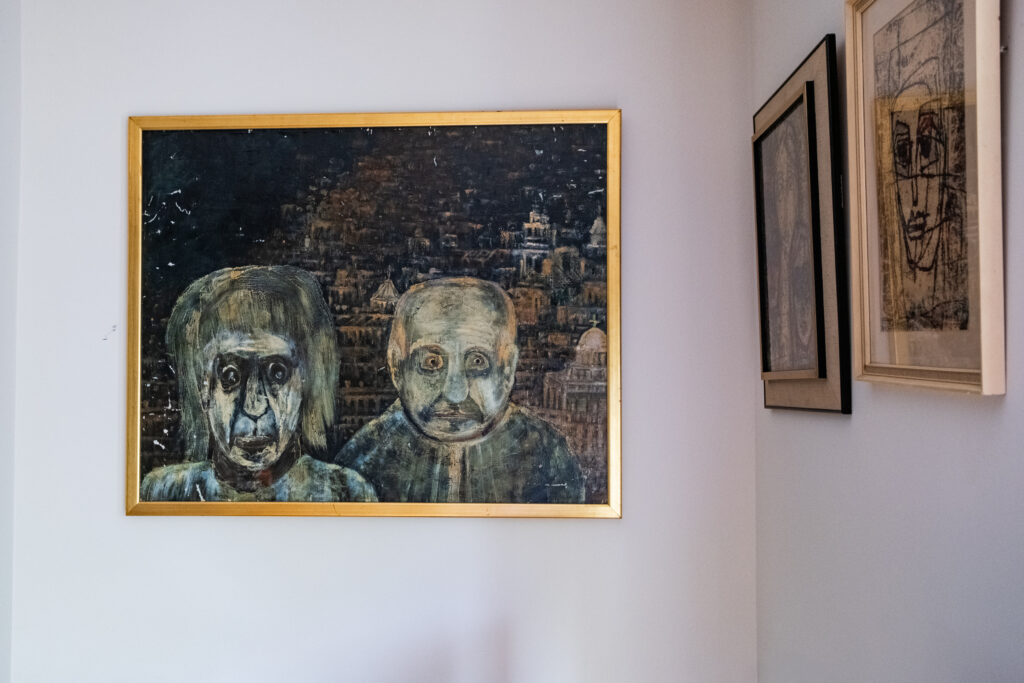 Artwork from the Iosif Levitan collection on display at the Francis Skaryna Belarusian Library and Museum, London. Photo by Tania Niden
The collection also includes the canvas Landscape with Chimneys (1989) by Artur Klinaŭ (1965, Minsk), a celebrated artist, photographer, and writer. This work likewise belongs to the underground current of Belarusian nonconformist art of the 1980s. At that time, Artur Klinaŭ viewed the representative of Belarusian culture as a contemporary partisan within urban space, and initially exhibited as a painter and performance artist. Landscape with Chimneys is a characteristic example of Klinaŭ’s expressionist period, during which he was the organiser of the BLO collective and a participant in exhibitions of the Forma group. In the 1990s, he turned to working with objects and installations. Together with Viktar Piatroŭ and Dzianis Ramanoŭski, he organised the international performance festival Navinki, and with Taciana Novikava, a video art festival. In the 2000s, Artur Klinaŭ turned to photography, film, journalism, and literature. His canvas Landscape with Chimneys is a unique work from the early period of his career.
From brutal expressionism, Klinaŭ moved toward Sots Art, which reinterprets and ironises the Soviet past. Irony and nostalgia are perhaps the chief markers of the artist’s objects, installations, and novels — whether these are suitcases filled with iconic books, birdhouses made from early-20th-century Belarusian furniture, or Partisan Boutique — a mobile installation built in the form of a shop selling objects from the Soviet era. In his photographic and literary project Minsk – The City of the Sun, Artur Klinaŭ reinterprets the architectonics of the Belarusian capital, which emerges as a vast installation or theme park, where the architecture embodies the stage-set of a “great utopia” or a “gateway” into the USSR. Klinaŭ works with mass cultural codes and architectural stage-sets in a series of works made from straw.
In recent years, the artist has developed a strong interest in working in film, where – now as a production designer – he creates “real” sets. There, as in the film Massacre (2010, directed by Andrej Kudzinienka), one can see a dynamic move away from figurative representation, symbolically expressed through the burning of the author’s straw works.
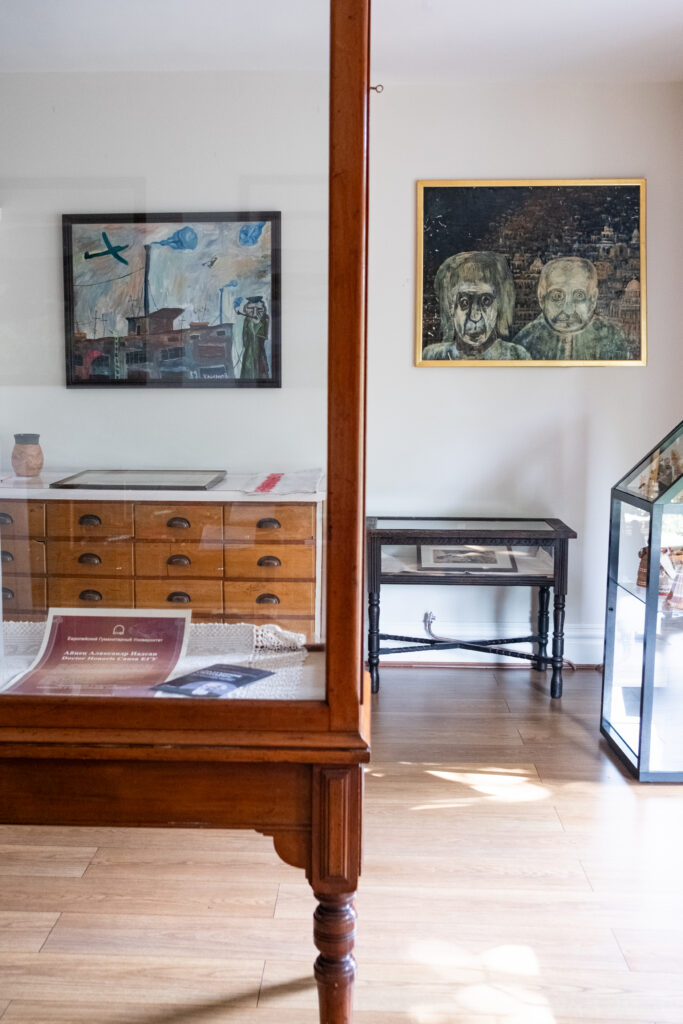 Artworks by Klinaǔ and Ždanaǔ on display in the gallery of the Francis Skaryna Belarusian Library and Museum, London. Photo by Tania Niden
Both paintings — by Ždanaŭ and Klinaŭ — were exhibited in 1989 at the First Republican Exhibition of Non-Traditional Art, Panarama (Minsk, an abandoned building at 27 Handlovaja Street), at the Exhibition of New East European Art at the Oosterkerk photo gallery (Amsterdam, the Netherlands), and at the exhibition Red and White at the Open-Air Museum (Amsterdam, the Netherlands).
To conclude, this collection of paintings presents striking examples of the styles and practices of Belarusian art from the end of the 20th century, from the realist — now already classic — landscapes of Vital Ćvirka to the underground experiments of Aliaksiej Ždanaŭ and Artur Klinaŭ.
Siarhiej Chareŭski, EHU, Vilnius
See the online gallery of the Iosif Levitan art collection in the website of the Skaryna Library and Museum