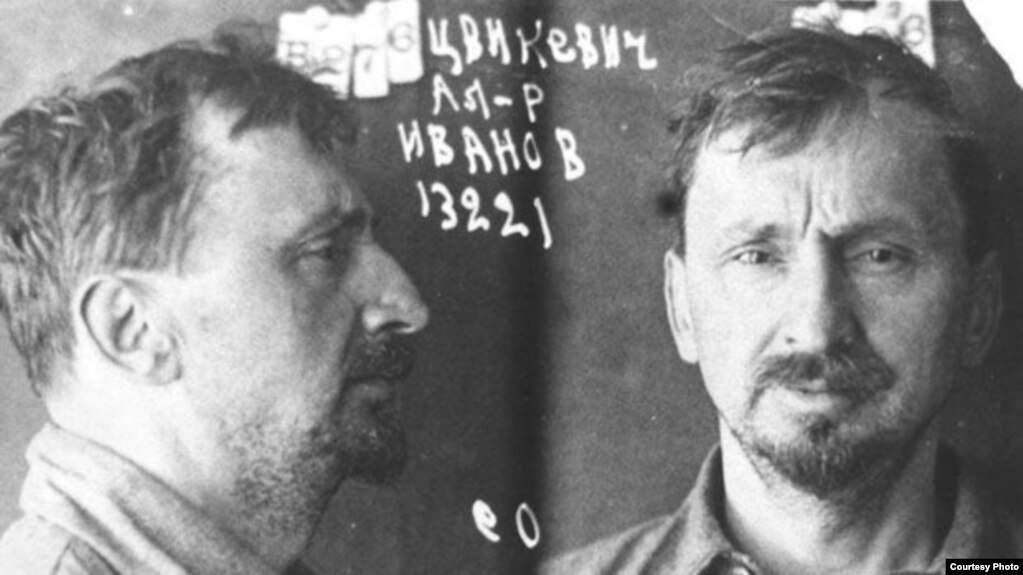
Alaksandar Ćvikievič (1888-1937), a well-known politician, lawyer, philosopher and publicist, stood at the origins of the diplomacy of the newly established Belarusian Democratic Republic and was a prime minister of its government-in-exile. Like many other figures of the Belarusian independence movement of the early 20th century, Ćvikievič became a victim of Stalin’s purges. His illustrious and tragic life story is retold at our exhibition The Unbroken.
Ćvikievič was born in Brest-Litovsk (now Brest in Western Belarus) into the family of a paramedic. Having received an excellent education at the Faculty of Law of St Petersburg University, he returned to his homeland and worked as a sworn attorney in Pružany and Brest-Litovsk. After the outbreak of the First World War, he was evacuated to Russia. There, in 1917, with other Belarusian refugees, he founded a society which demanded the autonomy of Belarus within the Russian Empire. At the end of that year, Ćvikievič was elected to the council of the First All-Belarusian Congress in Minsk. Later, together with another Belarusian politician, Symon Rak-Michailoŭski, he represented the executive committee of the Congress at the peace talks with Germany in Brest-Litovsk. Representatives of Soviet Russia headed by Leon Trotsky vetoed a separate representation of Belarus at the peace talks; our compatriots had to join the delegation of the Ukrainian Democratic Republic as their advisers.
In 1918, Ćvikievič worked as a member of a Belarusian diplomatic mission in Kyiv where he actively sought the recognition of the independence of Belarus by other countries, dealt with the state border issues and funding to the government of the Belarusian Democratic Republic. He also organised a Belarusian chamber of commerce in that city and published the newspaper Belarusian Echo. Later, he was part of the Council of the Belarusian Democratic Republic’s diplomatic missions in Berlin and Vienna. In 1921, he became the Minister of Foreign Affairs of the Republic, and, after the resignation of Vacłaŭ Lastoŭski in 1923, he headed the newly formed government-in-exile as prime minister. He shared his experience in diplomacy and politics in numerous publications on the matters of Belarusian statehood.
A passionate advocate of national self-determination, Ćvikievič supported the policy of Belarusianisation carried out in Soviet Belarus in the mid-1920s. In 1925, he convened the Second All-Belarusian Conference in Berlin where he proposed to cease the activities of the government-in-exile of the Belarusian Democratic Republic and to recognise Soviet Minsk as the only centre of the national and state revival. Although the Council of the Belarusian Democratic Republic rejected the proposal Ćvikievič’s proposition received support from many Belarusian activists in exile. Some of them, like the former prime minister himself, moved to Soviet Belarus to join Belarusian nation-building; soon after they fell victim to Stalin’s unfolding terror regime.
In Soviet Belarus, Ćvikievič worked in the People’s Commissariat (Ministry) of Finance and later – as an academic secretary of the Institute of Belarusian Culture (Inbelcult), the predecessor of the Academy of Sciences. His fundamental work, Westrussianism: Essays on the History of Public Thought in Belarus in the XIX and early XX centuries – a thorough study of the ideology and practice of Russification in Belarus during the Russian Empire – was published at that time; it has not lost its significance even today. The work was printed in parts in the Polymia (The Flame) literary journal. Immediately after it was published as a book in 1929, it was banned and almost the entire 3,000 print run was destroyed.
In 1930, the Soviet security services arrested Ćvikievič on trumped-up charges relating to the fabricated Union of Liberation of Belarus case and sentenced him to five years of exile. Ćvikievič served the sentence with his family in distant regions of Russia. He was re-arrested on 17 December 1937 and executed in Minsk two weeks later.
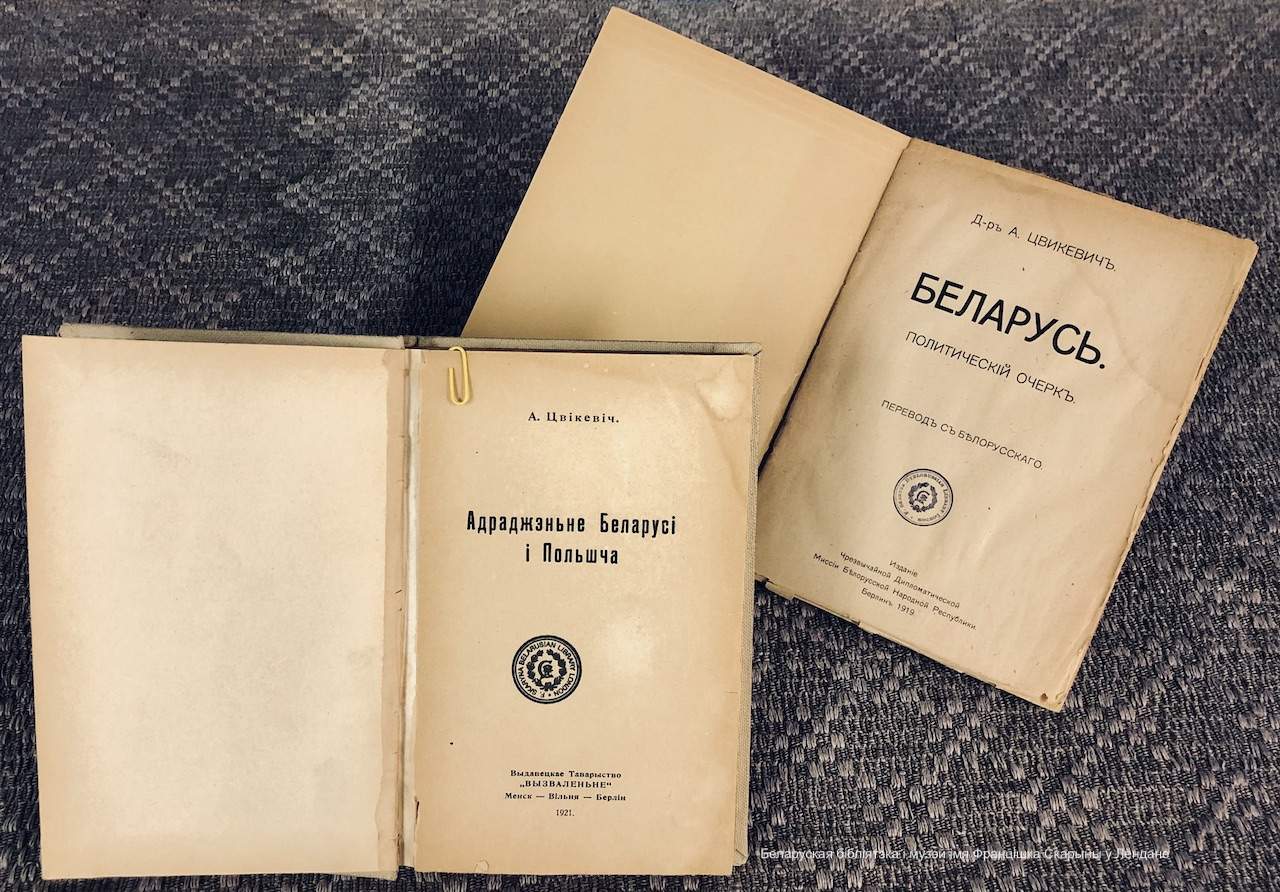
The Skaryna Library preserves the first editions of the following works by Alaksandar Ćvikievič:
Belarus’. Politicheskiy ocherk [Belarus. Political essay]. Berlin 1919. This political essay was intended to introduce western politicians to the issue of Belarusian statehood.
Adradžeńnie Biełarusi i Polšča [The revival of Belarus and Poland]. Minsk – Vilnius – Berlin 1921. In this book, Ćvikievič analyses the economic side of the then colonial policy of Poland in relation to Western Belarus. He underlines there that “the Belarusian national revival should be understood as an evolutionary, cultural process, which until now has been suppressed by violent measures of the police state and which now, under the conditions of free democratic statehood, must develop naturally, and – eventually – lead to independent Belarusian culture. This process will take time as it is dependent on the maturity of intellectual forces within our country, which cannot be created by administrative order of the state authorities.”