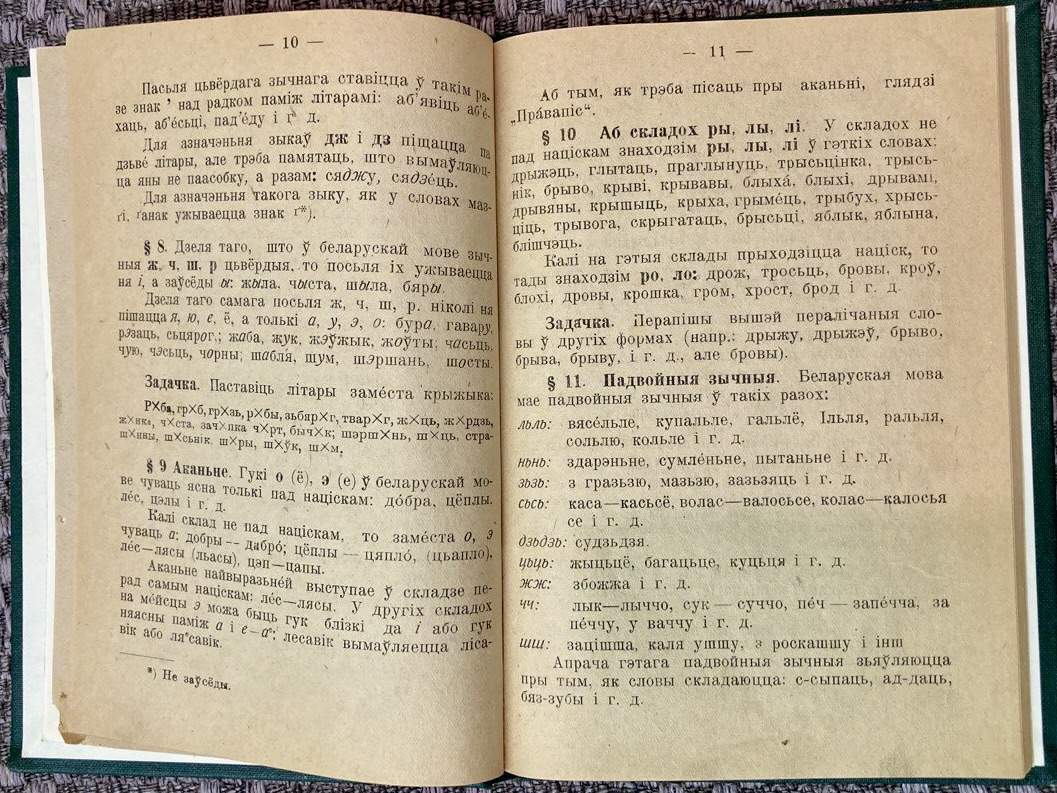
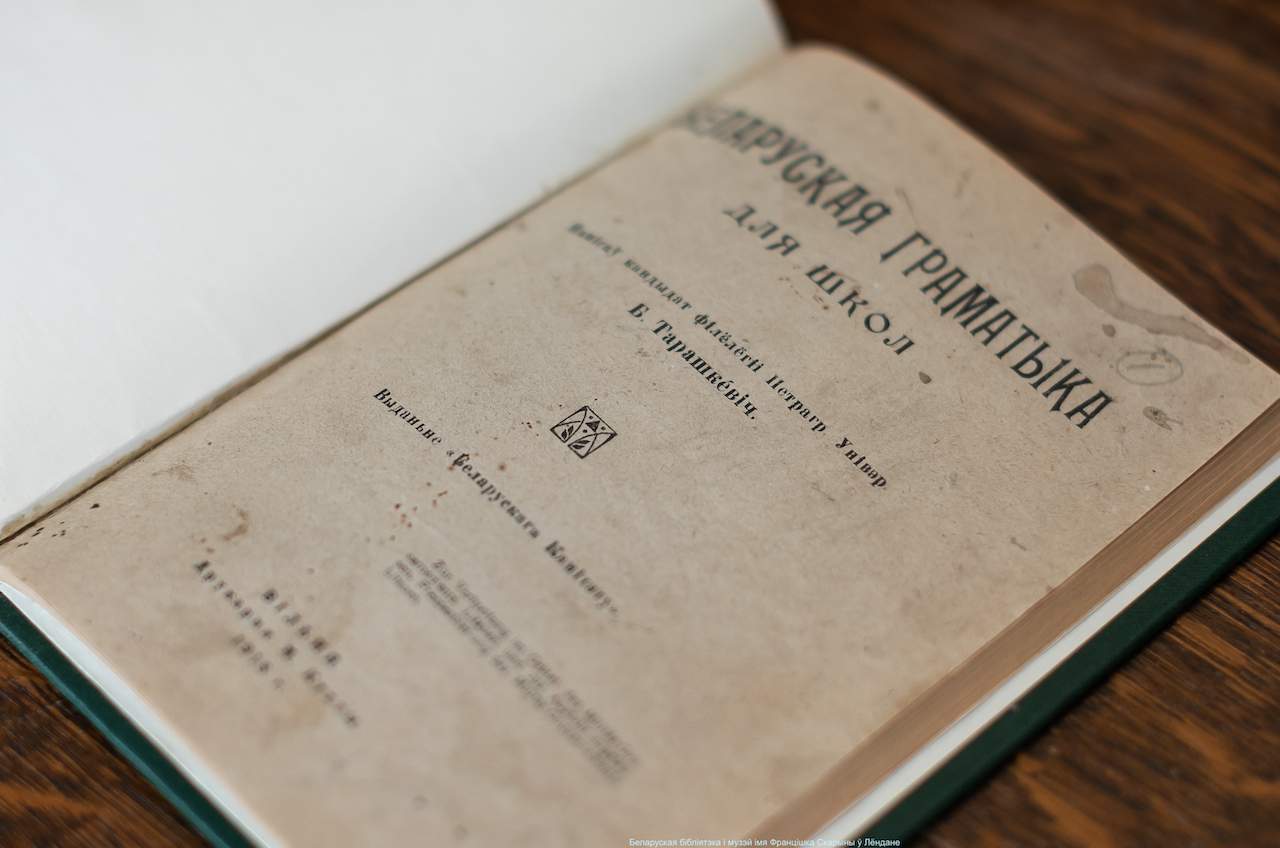
“Even if Branisłaŭ Taraškievič had published only his Belarusian Grammar for Schools, he would have remained in the annals of [Belarusian] national history forever,” says Uładzimier Arloŭ, a Belarusian writer and historian. Taraškievič’s textbook codified the grammar basics of the Belarusian literary language for the first time – the language of “the new Belarusian writing”, which developed from the local vernacular. The book was originally published in Vilna in 1918 in Cyrillic and Latin scripts. It has seen many editions since then. During the period of Belarusianisation of the 1920s in Soviet Belarus, it was the main textbook of the Belarusian language; later, it served as the foundation for new textbooks on the subject. The language norms laid out by Taraškievič became the care of the Belarusian classical spelling known as Taraškievica, i.e. the Taraškievič spelling. The first edition of Taraškievič’s Grammar in the Cyrillic version is featured in The Unbroken exhibition at the Skaryna Library.
Branisłaŭ Taraškievič (1892 -1938) was an outstanding Belarusian linguist, translator, publicist, and a public and political figure. He was born in the Vilna region into a peasant family, received a classical linguistic education at St Petersburg University and, for some time, taught Russian and classical languages there. He returned to Belarus in 1917. There, Taraškievič continued teaching and joined the Belarusian Socialist Assembly (Hramada), one of the first Belarusian political parties. In 1919, after the Soviet authority was established in Minsk, he left for Vilna. There, he headed the Belarusian sector of the Department of Education of the Republic of Central Lithuania, managed a local Belarusian gymnasium, and founded the Belarusian School Society.
In 1921, Taraškievič was elected a member of the Sejm (parliament) of the Second Polish Republic. From 1922 to 1924, he headed the Belarusian parliamentary group there. He became a co-founder of the pro-independence Belarusian Peasant and Workers Society and later joined the Communist Party of Western Belarus. The Polish authorities reacted badly to his rousing speeches and publications in defence of the Belarusian identity. In 1927, together with other leaders of the Belarusian movement in Poland, Taraškievič was accused of attempting a coup d’état and arrested. In 1928, he was sentenced to twelve years in prison. He was paroled two years later but rearrested in 1931. In the Polish prison, Taraškievič translated into Belarusian Homer’s Iliad and Adam Mickiewicz’s Pan Tadeusz.
He was released again through the efforts of the Soviet Belarus government: in 1933, the Polish authorities exchanged Taraškievič for Francišak Alachnovič, a Belarusian playwright and theatre producer who was serving a sentence in the Solovki Gulag camp in the Far North of Russia. According to an apocryphal story, during the prisoner exchange, Alachnovič exclaimed to Taraškievič: “Where are you going to, Bronia?!!”. “To the homeland!”, Taraškievič replied. Later, the Soviet authorities, however, did not allow him to live in his homeland: he was sent to Moscow to work at the International Agrarian Institute. Four years later, he was arrested in the case of the so-called ‘Belarusian National Centre’. According to official sources, Taraškievič was executed in 1938, but some researchers believe that he died in a Minsk prison after nine months of torture.
The tragic fate of this outstanding linguist destroyed by Stalin’s ruthless machinery of terror mirrors the destiny of Belarusian linguistics itself. Already in the second half of the 1920s, scholars actively discussed the need for further reform of Taraškievič’s grammar. An academic conference on orthography reform in 1926 considered the proposals of the Losik brothers and an extensive academic debate followed.
In 1930, Ściapan Niekraševič’s Spelling Commission prepared a project of language reform, but it had no chance to be implemented: the policy of Belarusianisation came to an abrupt end and was replaced with the persecution and arrests of the most prominent ‘Belarusian National Democrats’ – a derogatory term of the Stalin’s period for Belarusian political and academic figures. Leading linguists such as Losik, Niekraševič, Bajkoŭ and Łastoŭski, were first among those who were arrested in the so-called ‘Union for the Liberation of Belarus’ case; they were accused of de-Russification and Polonisation of the Belarusian language. As the Belarusian linguistic academic community was completely destroyed and its leading members were arrested or exiled, the authorities of Soviet Belarus carried out a language reform in1933; it brought the Belarusian spelling closer to Russian. This new spelling did not convey the assimilative softness and other distinctive characteristics of the language; it became known as ‘Narkamaŭka’, ie. the spelling of People’s Commissariat, and remains the official spelling of the Belarusian language to this day.
Although the Taraškievič spelling was discontinued in Soviet Belarus, it has lived in the Belarusian diaspora. Our library proudly continues the tradition of Taraškievica.